

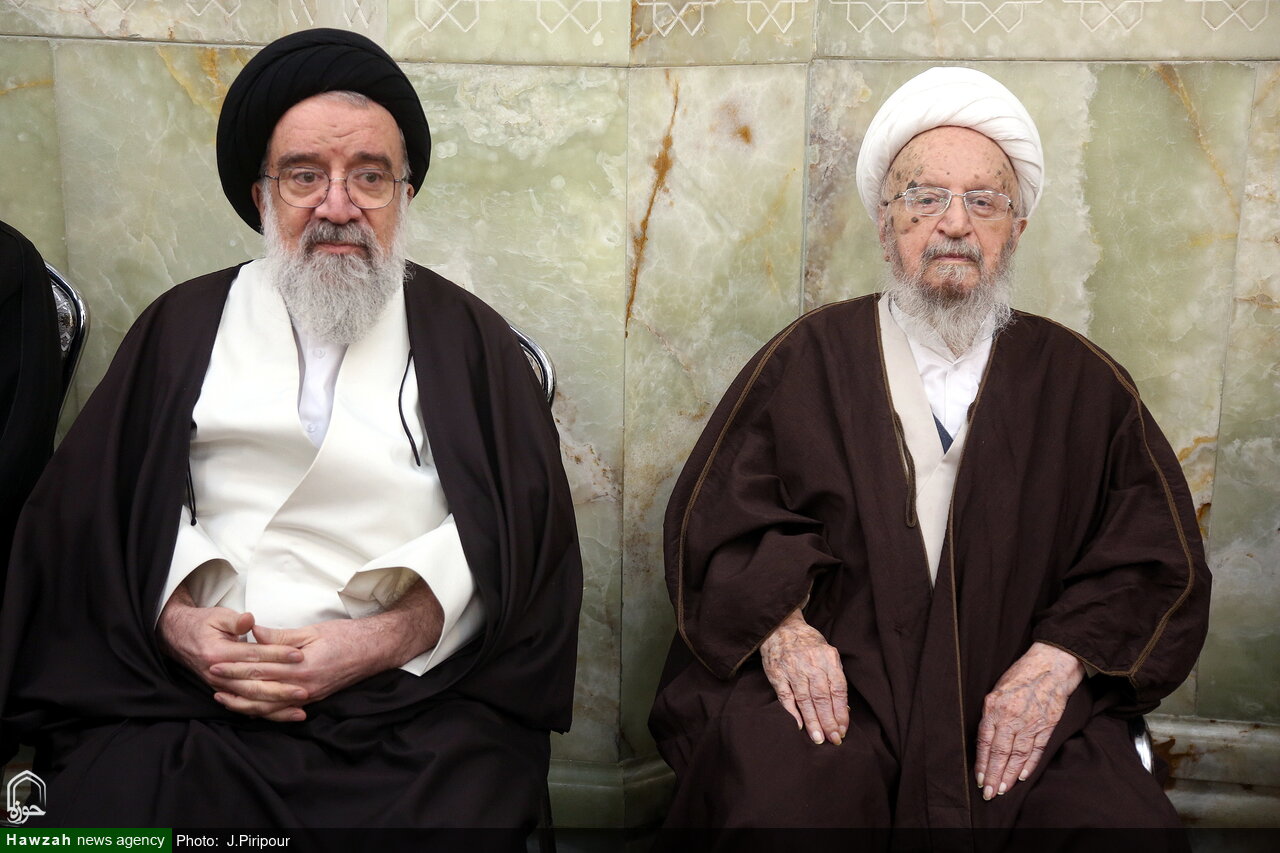
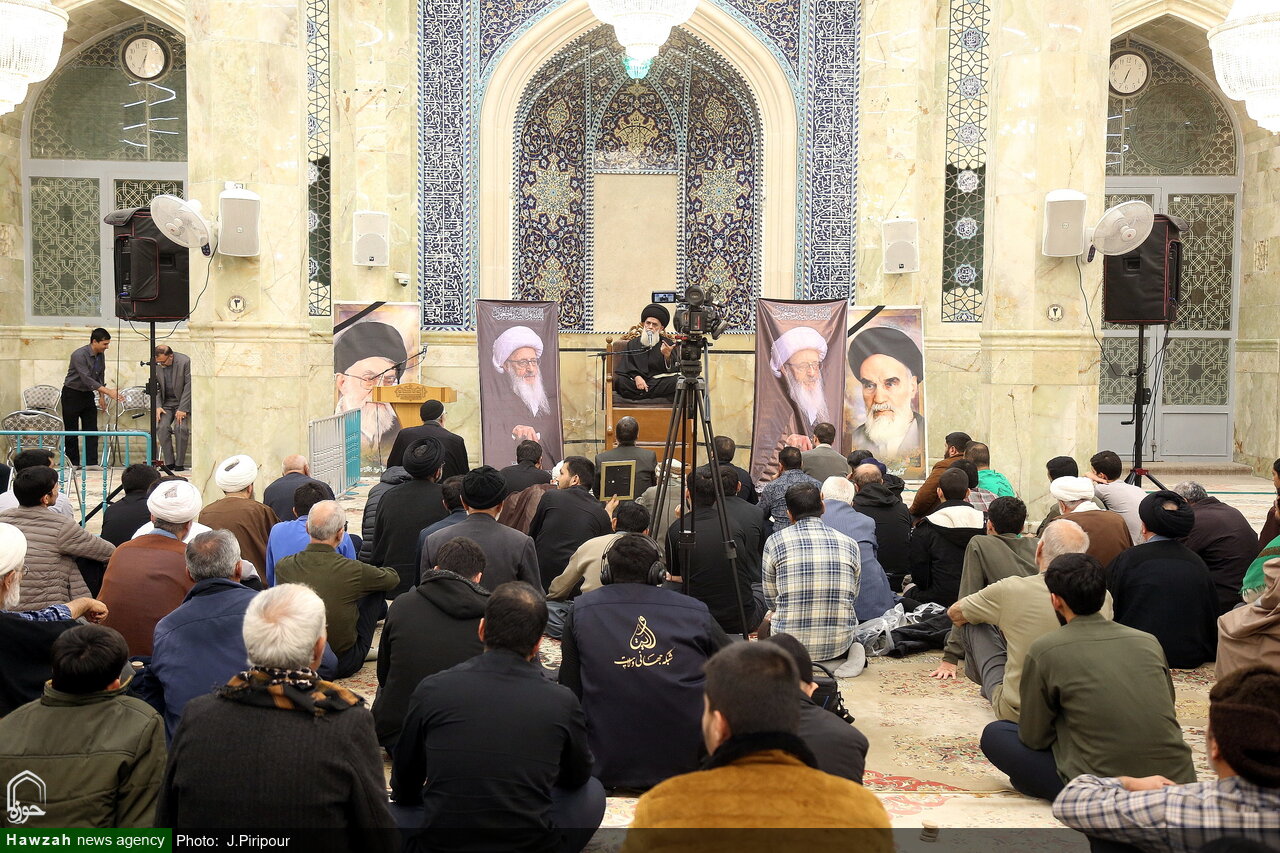
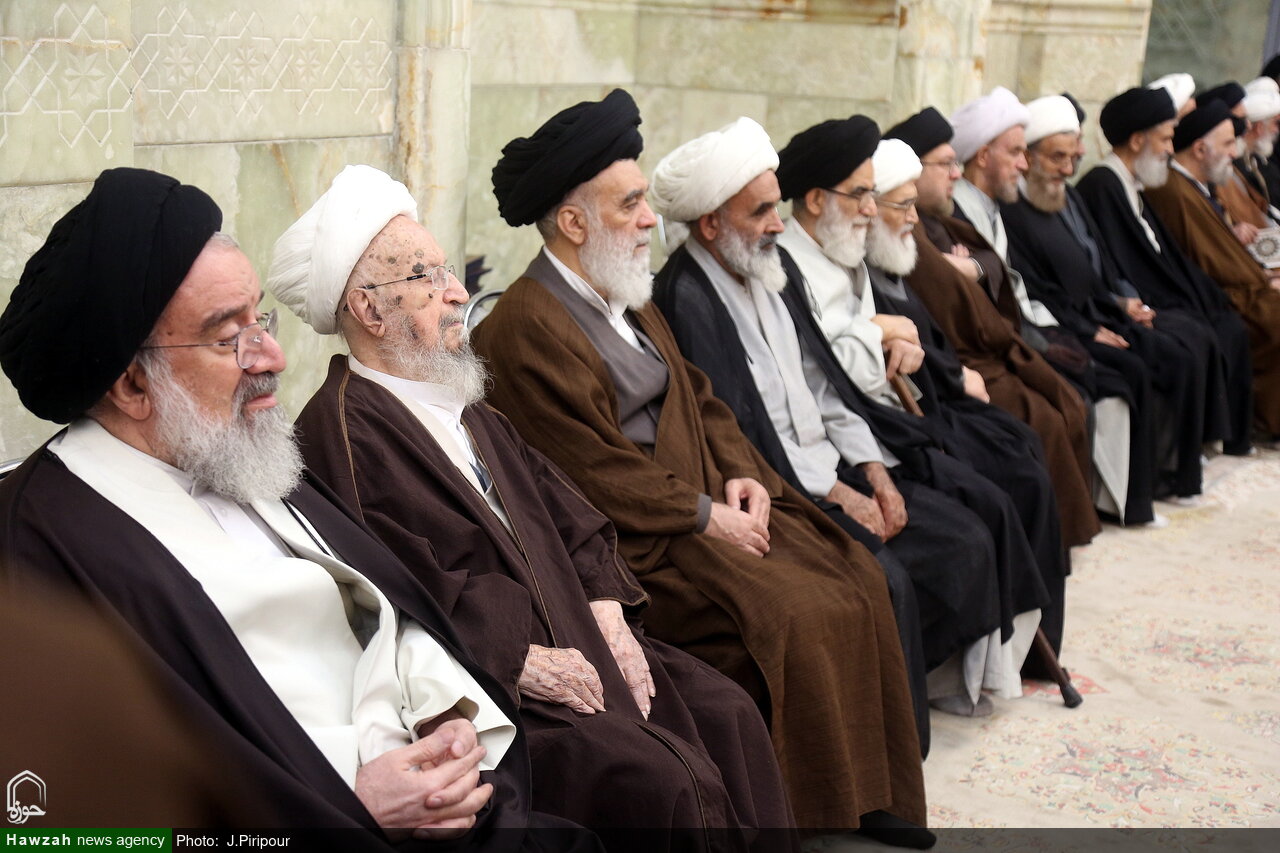
Hawzah News Agency- The memorial was organized by Grand Ayatollah Makarem Shirazi and attended by senior seminary figures, representatives of the offices of the grand marjas, members of the Supreme Leader's office, the Assembly of Experts, the Qom Seminary Teachers' Society, the Supreme Council of Seminaries, and the Guardian Council, along with a large gathering of scholars, seminary students, national and provincial officials, military and law enforcement commanders, members of parliament, and members of the public.
Hojatoleslam Seyyed Hossein Momeni, a professor at the Qom Seminary, shared memories from his student years, reflecting on the late marja's lifestyle, scholarly character, and devotion to the mourning ceremonies of the Ahl al-Bayt (peace be upon them).
"To Know the Great, Look at the Path They Walked"
The seminary professor opened his remarks by describing planning as the foundation of order and order as the support for the will to achieve one's goal. "Alongside a plan, a person needs a role model, and after the Infallible Imams (peace be upon them), who can be followed in every aspect of life, one should look to the conduct of scholars who walked the path of the Ahl al-Bayt, remained steadfast in it, and whose behavior showed no trace of dependence on anything other than God," he said.
Noting that many scholars taught in the Grand Mosque, and that some young seminary students today do not even know the names of some of them, he added: "The purpose of honoring scholars is not merely to keep their names and reputations alive; rather, we must see what path they walked that allowed them to influence others during their lifetime and, after their passing, to serve as a model for those who wish to follow the same path."
To illustrate this, Momeni cited Shahid Awal (the First Martyr), who wrote the juridical text al-Lum'a in prison and whose grave site was lost after his martyrdom, yet despite the many books written after him, his work is still studied in the seminary and his name remains associated with the defense of the jurisprudence of the Ahl al-Bayt (PBUT).
The seminary professor also referenced the status of the late Akhund Khorasani, saying he is best known for Kifaya, a solid and difficult text whose difficulty helps train students to understand complex writings and narrations. "But if we want to know why this scholar's work has endured, we must not overlook his character and spiritual life, because what gives a person's work lasting value is sincerity and doing it for God," he said.
An Account of Grand Ayatollah Boroujerdi’s Prudence and His Trust in Divine Guidance
Momeni noted that the views of Grand Ayatollah Boroujerdi, the founder of the Grand Mosque of Qom, are still studied in advanced courses in jurisprudence and principles. "Alongside his scholarly standing, we must also pay attention to how he made decisions in difficult situations," he said.
"Grand Ayatollah Vahid Khorasani Stood at the Pinnacle of Humility"
Describing Grand Ayatollah Vahid Khorasani, Momeni said he stood at a pinnacle of humility. "The scholarly rank of this late marja is well known to the seminary community, but what his students witnessed in their dealings with him, beyond his scholarly ability, was his servitude to God, his discipline, his planning, and his continuous effort, which meant he would not let a single moment of his life pass in vain," he said.
"He Told Seminary Students to Seek the Attention of Imam Mahdi (PBUH)"
Recalling that he attended Grand Ayatollah Vahid Khorasani's lectures at the Grand Mosque of Qom for about ten to eleven years, Momeni remembered the day when the marja's brother and nephews donned clerical robes. "What I heard from his own lips, and which still moves me when I recall it, was that he told them: 'Do something that brings you to the attention of the Hujjat ibn al-Hasan (may God hasten his reappearance).' This advice was consistent with his own way of life, because he did not seek to have his deeds noticed by others," he said.
Momeni also described the late marja's burial place as consistent with this spirit, adding: "The late marja said he wanted to be buried at the feet of Imam Reza (peace be upon him), and his grave is now not even located in the men's section of the holy shrine, but what mattered to him was his wish to rest at the feet of Imam Reza."
Momeni added that Grand Ayatollah Vahid Khorasani's attention to Imam Mahdi (May God hasten his reappearance) was not limited to speeches and occasions; he repeatedly advised students to recite the Quran and dedicate its reward to the Hujjat (may God hasten his reappearance) for a better understanding of scholarly matters, placing this advice alongside the effort, study, and precision to which he himself adhered in his scholarly life.
A Narration He Knew by Heart but Read from the Book
The Qom Seminary professor recalled Grand Ayatollah Vahid Khorasani's sermons on the fifteenth of Sha'ban at the Grand Mosque of Qom. "I clearly remember at least two or three years when he would read the narration of the Banu Israel prayer from the second volume of Tafsir al-Ayyashi to the people, and although he knew the text by heart, he would place the book before him, and as he read it, his voice would break and he would weep," he said.
Explaining the narration cited by the late marja, Momeni said: "According to that commentary, the affliction of the Banu Israel was to last 400 years, but when 230 years had passed, they spent forty days and nights weeping and pleading with God to end their affliction, and God forgave the remaining 170 years and commanded Moses and Aaron (peace be upon them) to deliver them from Pharaoh's grasp."
Noting that Grand Ayatollah Vahid Khorasani's purpose in reading this narration on the fifteenth of Sha'ban was to draw people's attention to the importance of praying for deliverance, Momeni continued: "After recounting the story of the Banu Israel, he would read the final part of the narration, in which the Imam (peace be upon him) says that if the Shi'a were to supplicate and plead in the same way, God would bring about the deliverance."
Recalling the marja's tone when supplicating at the Grand Mosque, Momeni said: "When he said 'Ya Sahib al-Zaman,' it was as if the pillars of the mosque trembled, and when he spoke of the mother of Imam Mahdi, he himself would tremble from deep emotion, moving his listeners as well."
He added that this impact was not limited to recent years. "When I obtained some of the late marja's old recordings in Mashhad through one of the owners of a Hussainiya and listened to several of them, I realized that his words carried the same influence from decades ago, and the memory of the voices of Grand Ayatollah Vahid Khorasani and Grand Ayatollah Makarem Shirazi at the Arq Mosque in Tehran is still alive," he said.
Momeni further stated that alongside his scholarly lessons and discussions, Grand Ayatollah Vahid Khorasani attached special importance to holding mourning ceremonies for Imam Hussein (peace be upon him).
"During Fatimiyya, He Considered Going to the Shrine of Hazrat Masoumeh Part of the Mourning"
Noting that Grand Ayatollah Vahid Khorasani's absence was felt this year at the mourning ceremonies and procession marking the martyrdom anniversary of Hazrat Zahra (peace be upon her), Momeni said: "He would tell others, 'Speak of Fatima,' and on the day of Hazrat Zahra's martyrdom, he would remove his turban, take his cloak off his shoulders, unbutton his robe as a sign of mourning, and walk barefoot to the shrine of Hazrat Masoumeh to offer condolences on the martyrdom of Hazrat Zahra to the Karima of the Ahl al-Bayt."
Recalling that it had been suggested the ritual be held at Jamkaran Mosque or another location, he added: "Grand Ayatollah Vahid Khorasani insisted on going to the shrine of Hazrat Masoumeh, saying 'the shrine itself is the point,' meaning the purpose of this act was to go to the shrine and offer condolences in the presence of Hazrat Masoumeh."
Momeni, who said he had the privilege of reciting eulogies in the marja's presence on the day of Hazrat Zahra's martyrdom for several years, recalled: "Once, on the evening before the day of martyrdom, they called me from his house and conveyed his message: 'The Ayatollah says the content of your speech can be delivered to the people throughout the year, but tomorrow is the day of your mother's martyrdom, so do not fall short in reciting eulogies for her.'"
In the final part of his remarks, the seminary professor said: "I myself heard the eulogy of Amir al-Mu'minin's loneliness at the moment of burying Hazrat Zahra from Grand Ayatollah Vahid Khorasani, and I remember he would advise that after recounting the tragedies of Sayyid al-Shohada (peace be upon him), one should also mention the oppression of his father with the phrase 'Mazlum Ali.'"
The ceremony was organized by Grand Ayatollah Makarem Shirazi, and his presence at the memorial for Grand Ayatollah Vahid Khorasani served to honor the scholarly standing and services of the late marja to the seminaries and the school of the Ahl al-Bayt (PBUT).
Grand Ayatollah Makarem Shirazi had previously issued a message of condolence on the passing of Grand Ayatollah Vahid Khorasani, praising the scholarly and religious services of the distinguished jurist.
Part of the message reads: "This godly scholar spent his blessed life defending the path of guardianship and the school of the Ahl al-Bayt and guiding the faithful, and he spared no effort in reviving the cause of those holy figures, especially in defending Fatimid and Alawite teachings."
Grand Ayatollah Makarem Shirazi also described the late marja's prolific teaching chair, the training of students, and his scholarly writings as lasting blessings of his scholarly life, emphasizing that the seminaries of Qom, Najaf, and Khorasan will benefit from the fruits of these activities.
At the end of the message, he offered his condolences to Hazrat Wali Asr (may God hasten his reappearance), the seminaries, the noble family, and the children of the deceased, and asked for elevated ranks for the late jurist and patience and great reward for the bereaved.
It should be noted that a memorial ceremony for Grand Ayatollah Vahid Khorasani organized by Grand Ayatollah Javadi Amoli will be held Friday after Maghrib and Isha prayers at the office of that marja.

Your Comment